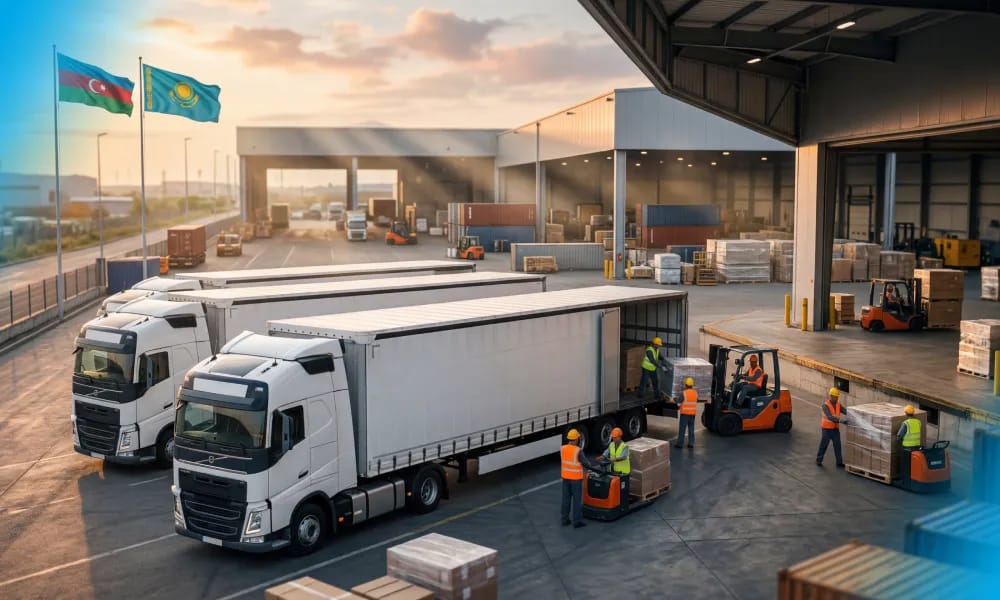
Freight Transport from Central Asia to Azerbaijan
Importance of the Central Asia–Azerbaijan Logistics Line
Role in Regional Trade
Freight transport from Central Asia to Azerbaijan is one of the key pillars of interregional trade. This route not only connects two geographic areas but also serves as an important logistics channel that ensures the continuity of economic relations. Cargo transported from Kazakhstan, Uzbekistan, and other Central Asian countries enters the Azerbaijani market and spreads to broader regions, increasing trade volume and expanding business operations.
The Advantage of Stability and Continuity
The main advantage of this route is its stability and continuity. When goods are transported in a planned manner, the trade chain remains intact, allowing businesses to plan their operations more easily. KOMETA KZ manages the logistics process in this direction in a systematic and effective manner, offering customers not only transportation but also a reliable platform for growing their business.
Position in the East–West Connection
The Central Asia–Azerbaijan route is a vital part of the main logistics line connecting East and West. Goods transported along this route reach a wider geography, strengthening international trade relations. Azerbaijan plays a key role as a transit country in this route, contributing to the development of interregional connections.
This Logistics Line’s Role in International Trade
This logistics line is one of the primary routes in the development of international trade. It carries raw materials and finished products for various industries, facilitating the seamless operation of production and sales chains.
Global and Regional Logistics Trends
Increase in Trade Flows
In recent years, trade relations between Central Asia and the South Caucasus have rapidly developed, increasing the demand for logistics services. Companies are looking for faster, safer, and more cost-effective transport solutions, accelerating the development of the market.
The Role of Transit Countries
Transit countries like Kazakhstan and Azerbaijan play a crucial role in this logistics system. Through these countries, goods gain access to broader markets.
KOMETA KZ’s Logistics Approach
Comprehensive Service Model
KOMETA KZ offers not just freight transport services but complete logistics management. In this model, all stages of the process—planning, transport selection, and delivery—are managed within a unified system. This approach ensures the process is more effective and controlled.
Planning and Coordination
Each shipment is planned and coordinated in advance. This prevents delays and ensures the stability of the logistics process.
Freight Transport by Road
FTL (Full Truck Load) Transport
FTL transport offers the optimal solution for large-volume cargo. In this model, cargo is transported directly to its destination with no additional operations.
LTL (Less Than Truck Load) Transport
LTL transport is a more cost-effective option for smaller cargo. This model allows for cargo from multiple customers to be consolidated and transported together, optimizing costs.
Transport of Heavy and Oversized Cargo
Lowbed Transport Vehicles
Transporting heavy machinery and oversized cargo requires specialized vehicles. Lowbed platforms are considered the most effective solution for this.
Technical Logistics Solutions
Such shipments require not just transportation but also technical planning. KOMETA KZ offers professional expertise in this area.
Multimodal Logistics Solutions
Integration of Road and Rail Transport
Multimodal logistics combines different transport modes to create a more effective shipping solution.
Logistics Optimization
This approach ensures more effective use of time and resources.
Conclusion
Freight transport from Central Asia to Azerbaijan remains one of the key directions in interregional logistics. With its comprehensive and coordinated services, KOMETA KZ offers reliable and optimized logistics solutions to its customers.
How long does it take to transport goods from Central Asia to Azerbaijan?
The duration depends on the route and type of transport used.
